29 June 2012
The boardgame and the flashcards
Before the era of online games in my household, the kids and I played a lot of UNO, Snake and Ladder and Monopoly. There were other games of course, but for some reason, the kids kept asking me to play these games with them. So it was no surprise that these three games had influenced the Dusun Cultural boardgame that my friend and I invented recently. It started in a very peculiar manner. We were trying to bear one of those long, repetitive 'department' meetings, and ended up talking about our research and how we could possibly combine our knowledge in creating a language boardgame. My friend scribbled down some ideas, as we excitedly brainstormed in whispers. We got through the meeting, and ended up with loads of ideas for an ambitious game.
To cut a long story short, the end product though wasn't as elaborated as we planned it initially because of time constraints. I decided to take on the task of game designer, based on some of the friend's research findings. We selected a few words relevant to the culture of the Dusun people- of which, some are not in use anymore. We thought it would be great to teach the learners these words (in our case in UMS, the learners are non-native speakers of any Kadazandusun dialects, thus learning the KD language as a third language).
Because we didn't even have the time to rope in our friends who are IT experts in UMS, we have (or rather I have) begged Kastumized.com to transfer our game concepts into IT. I am very impressed that despite having less than a week to do it, they actually did a wonderful job. They gave us a wonderful board and rewards/sanction cards. And my son lent me his lego pieces to be the player icons. A dice completed the game. The night before we presented the game for the PEREKA (literally 'inventor') competition in UMS, I had some KD students played it (before, I piloted on my 3 kids-the best critics, twice). When I saw my students having so much fun playing it, I knew we had done something worthwhile.
And yes, we bagged a Silver Medal for that simple game. Credits to Kastumized.com team, of course!
Well, another kastumized.com story. I have always been personally impressed with this young company, run by a team of resourceful, smart, and versatile young professionals. Their recent product is a set of English-Kadazandusun flashcards. I have willingly vetted the contents based on my knowledge of 'Kadazandusun'. To those who are not aware of the language scenario in Sabah, there are many labels used to refer to the various ethnic and language groups sharing similar culture and dialects. Kadazandusun is the general term used nowadays to refer to the many ethnic groups who share the same culture and speak dialects of the same language.
Many would be familiar with the term Kadazan, most often associated with the 'Kadazandusun' people of Penampang and Papar areas. Dusun, is also quite a popular term. I refer to myself as Dusun, as I believe I should define my ethnicity based on the language of my community. To be specific, I am a Bundu Dusun. Now, Bundu and Liwan are two prominent dialects spoken in most areas (mostly interior)in Sabah. You'd find Bundu in Kota Belud, Kota Marudu, Tamparuli, and Ranau, mostly. While you'll find Liwan in Ranau, Tambunan and Keningau, mostly. Among Bundu and Liwan themselves, there are many other labels and sub-dialects.
My friend's phd research (the friend who co-created the boardgame) is on the political system of the Kadazandusun people. (and he is not even a Kadazandusun- he is from Malaya). For over 4 years he went to all the places inhabited by the different Kadazandusun people in Sabah, and has come to this conclusion: 'The most widely spoken dialects of Kadazandusun are Bundu and Liwan'. I am quite relief to hear that. Not because I am a Bundu speaker. But because it justifies the merit of basing the so called standard Kadazandusun language taught in Sabah schools on Bundu/Liwan. Dusun Sokid (another referent :)= meaning 'upper', 'hill') or not, these dialects actually count.
What has that piece of long info got to do with the flashcards? Well, because in Sabah, any sincere and innocent efforts to add to the existing Kadazandusun educational aids will STILL be CRITISISED. I don't blame people for criticising. It's human nature after all. If one said, for example, that the word 'Kolibambang' is wrong for 'butterfly' because in their dialect it is 'Bambayangan', it is merely a dialectal difference. I did a few months data collection among speakers of Bundu, have been living next door to Liwan speakers most of my life, and know for a fact that 'Kolibambang' means 'butterflies' (you know those beautiful, colourful bugs) in these dialects. So yeah, there's no satisfying people. The only way to be satisfied is to do the research yourself- I am lucky I am in the position to do so. And I always encourage the Kadazandusun people to enrich the standard KD languages by having a lot of synonyms (next project, Kastumized? Kadazandusun synonyms :). So we can have bambayangan and kolibambang as synonyms, and be happy!
Anyhow, the intention was to congratulate Kastumized for the flashcards. The size was a bit small for me, but just nice for my son who has been devotedly reading the cards day by day. His conclusion was ' That's all, Mom?". Obviously wanting more!
27 May 2012
Sinurambi
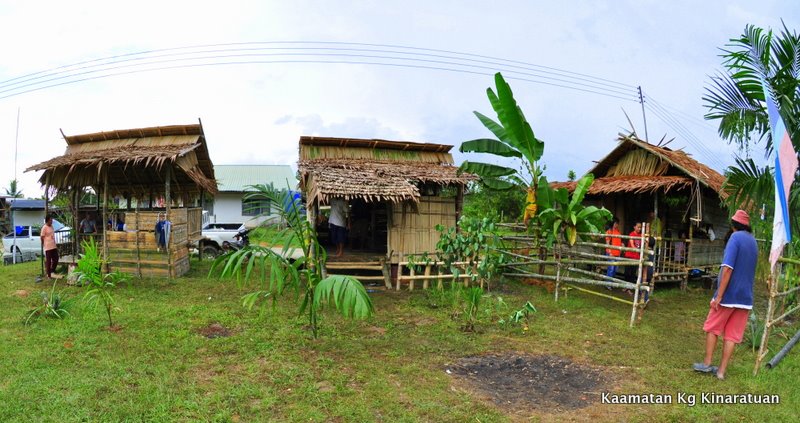
This is how they look like. Sinurambi, the dwelling place of the Dusun long ago. (Well, not quite- some Dusun in some villages still live in huts like these). I haven't seen these in my (father's) kampung for years, except in the tumoh (farms). Not in the actual housing areas, in which the houses you can see are the standard brick/wooden combination. This year, the Kaamatan organizers came up with this wonderful idea of having 'most impressive sinurambi' competition. I would say this is not one easy competition. A lot of efforts and time are involved, but the villagers delightedly participated. They were divided into groups, and it took them days to build their sinurambis. Not an easy task at all. Selecting the best bamboos, manata' (flattening the bamboo in order to make the floor and walls), putting the parts together. The architecture might not seem much, but I am proud to see these. To me, this is one of the most meaningful aspects of kaamatan. Popotungkus do koubasanan kumaa doid sukod wagu (passing down tradition to the young generation).
(The winner of the most impressive sinurambi competition)
I regret not being able to go back to my kampung (duty call). Thankfully hubby shared these pics. Kotobian tadau kaamatan folks. May the year ahead is abound with blessings and fruits of your labour!
25 April 2012
Thank you for being my Dad
It wasn't a common practice for a Dusun to explicitly appreciate his/her parents. In my household, I didn't grow up seeing family members express their 'thank yous' and 'I love yous'. In fact what I remember most from my childhood is when an older member of the family behaved weirdly (as in starting to be forgetful, or being incoherent) the younger family members would raise their voices to the person. If one is an outsider, one would undoubtedly look at that kind of treatment as 'mean' and perhaps 'ungrateful'.
There were times when I got confused, myself. In my mind I often wondered whether I was supposed to treat the older person that way or not. I supposed having gone to school with the mainstreamers (so-called modern people), and having been taught about certain ways to respect the older members of the family in moral and religion classes contributed to the confusion. But I now understand that that kind of treatment was never intended to be negative. From conversations with many people of my mom and grandmother's generations, I deduce that life is perceived as a circle. One starts as a baby, one will end up being 'a baby' too (limited mobility, limited brain capability etc), because that was how it used to be with the community. Just like a little child is 'corrected' by his/her parents' raised voice, an elderly person who behaves like a child is also corrected the same way.
I am glad that we do not have to confine ourselves to that culture anymore. I still feel awkward saying 'I love you' to my parents because I don't remember them ever saying that to me. But I encourage myself to say that to my kids and dear hubby because I think life is so wasted without hearing those beautiful words said to you.
When I came across this song "Thank you for being my Dad", I feel so much like appreciating my Dad. For all the things he has ever done. Despite the mistakes that he did in the process of becoming the Dad he is now. I feel blessed for still having a Dad. Thank you Bapa, for being my Dad.
12 April 2012
What a song does (re: "Koposionku")
Sometimes when you hear a certain song, you feel that it penetrates deep into your soul. Even if you don't understand the language of the song, it still touches your heart deeply. And when you understand the lyrics, the song is even more meaningful.
Fabian William's "Koposionku" is one such song. I don't speak music, but I feel that the music and lyrics of this song match very well. (And yes, I know this is the third entry on Fabian William that I've written but I just can't help it :). As my students put it, we have caught the Fabian Virus.) But seriously, "Koposionku" communicates pain and strength beautifully using gripping metaphors. By now, after listening to Fabian's 10 songs over and over again, I've started to see metaphors as his trademark. His, are uniquely Dusun, that can only be fully appreciated if you know the Dusun culture well. Here's my attempt to understand "Koposionku" (My apologies that my translation doesn't do justice to the beauty of his expression in Dusun):
Koposionku
Nokito, naratu om nababak
iso ginawo nosungkadan
nosindualan, natagakan
kagarasan di naramit
(What is seen is a heart: fallen, broken, pierced. Lost the strength it received)
Om au tumonob ilo tadau
nung au tumalib kotuongon
ilo gompoton au rumikot
nung gompion ginawo di nosuhat
(and the sun doesn't set, if the darkness doesn't pass, what is desired won't come, if [you] hold on to your broken heart]
kibito nimpusadan
suloko liud tumuka
igitai gamut kotumbayaan
om au noh orulun kumaa id sawa
[don't reject the tears [there's no exact translation for 'nimpusadan'], walk through the flood while holding on to [your] faith, so that [you] won't get washed away downstream]
Oposik, tumungag om mingkakat
mamanau miagal dilo wokon
kosindualan, koinggoritan
uludon, impohon tumindal
[[then you'd be] awake, get up and stand, walk like others do [with pride]. The pain, the suffering, arrange them and step on them to resurface [overcome your pain])
This song is also a bonus to my Kadazandusun class this semester. The verbs exemplify events that one doesn't have control over (accidental action- as we call it in my classroom). What better way to learn than through songs, I'd say.
Subscribe to:
Posts (Atom)