23 September 2012

Lyrical prayers

I think the closest persons to language teachers in the olden days in the Dusun community were the bobolians. To be one of them, one has to go through a few stages of learning and memorizing prayers for numerous occasions. Pronunciation was of utmost importance in saying a prayer. Should a bobolian mispronounced a word, leave out a part, or leave the prayer unfinished, the wrath of the bad spirit would cause her and her family members to be sick. And the length of the prayer ranged from three minutes to one hour! Imagine, saying a one-hour prayer without a single mistake in pronunciation, words, and phrases. I would have failed miserably... Anyway, as I read through old research notes, suddenly I appreciate the beauty of a prayer that a bobolian was kind enough to share. What lyrical prayer! It's the prayer for protection. The ritual involved releasing the bobolian's spirit to soar like an eagle to seek the Creator's blessing, carrying with her a rock, a wooden stick, and some water. Upon reaching the Creator she'd ask for His blessing to be imparted on the things she brought, and the Creator would say: Onuo ilo pampang om puruto ilo dandas (so pick up the rock, pick up the rock) - pampang/dandas = rock (synonyms) pampang turu sonsusun (seven rocks arranged together) dandas walu sonsugo (eight rocks arranged together) - sonsusun/sonsugo = in an arrangement (synonyms) om onuon nu'd poningolig (and those taken to protect) puruton nu'd poningobon (those taken to protect) - poningolig/poningobon = things used to protect(synonyms) There's a lot of meaning repetitions, using different words to emphasise the intention I presume. The rest of the prayer is very long, and beautiful...I like the bit where the Creator said: Ogumu noddi narangkai nu, (you have collected a lot [of blessing]) asapou noddi naraut nu (you have gathered heavy [blessing]) anu 'lo poposdu (get some of the cleansing water) purut dilo lituntug (get a bit of the cleansing water) ... and empowered her to use the water as 'holy water' to get rid of illnesses. Sometimes I wonder how would it have been had I lived in those days...

25 July 2012

Appearance is deceiving

My aunt told us this story yesterday- she went to our small town post office to get a parcel for my cousin. There was an old man queueing up to do a banking (Amanah Saham) transaction. He wasn't sure what form to use, so my kind aunt assisted him. He asked some people to help him fill up the details on the form, but none was willing to. Seeing that, my aunt offered to help. When she asked him how much money would he like to bank in, he said "ten, and 500 for the wife". It turned out that he was banking in "10,000". He gave my aunt a 10 ringgit tips after she had completed the two forms for him. She refused, but he insisted...and I bet those three people he approached to help him earlier were shocked to know he had that much money to bank in. Well, he reminds me of my late grandfather, my aunt's father. He used to go to town wearing simple clothes, and a baseball hat, with his old green kantung (canvas sling bag) that had seen better days. He would sell bahar (coconut sap) at the weekend tamu (open market) and since he was the only one that had a licence to sell 'alcoholic beverages' in the whole tamu then,(bahar is alcoholic!), he would let others sell under his name and taxed them RM1 per day. Being the hardworking man he was, he often managed to bank in quite a large amount of money at a time, just like the old man that my aunt helped. My grandfather was illiterate, unless if you consider being able to write his name and a few simple sentences literate. [The most hilarious thing he ever wrote was "PANABUT (Penyabut) ATAS ATAP" (screwdrive on the roof),on one of the walls of his house, that was meant for his children, but could have easily gotten him robbed if the wrong party saw it. Anyway, that was 'ama' = 'father' (that's what his children, grandchildren and great-grandchildren called him)]. Moral- an ugly looking Dusun person might have lots of money on them. (phew, writing this makes me miss my late grandfather very much)

29 June 2012

The boardgame and the flashcards

Before the era of online games in my household, the kids and I played a lot of UNO, Snake and Ladder and Monopoly. There were other games of course, but for some reason, the kids kept asking me to play these games with them. So it was no surprise that these three games had influenced the Dusun Cultural boardgame that my friend and I invented recently. It started in a very peculiar manner. We were trying to bear one of those long, repetitive 'department' meetings, and ended up talking about our research and how we could possibly combine our knowledge in creating a language boardgame. My friend scribbled down some ideas, as we excitedly brainstormed in whispers. We got through the meeting, and ended up with loads of ideas for an ambitious game. To cut a long story short, the end product though wasn't as elaborated as we planned it initially because of time constraints. I decided to take on the task of game designer, based on some of the friend's research findings. We selected a few words relevant to the culture of the Dusun people- of which, some are not in use anymore. We thought it would be great to teach the learners these words (in our case in UMS, the learners are non-native speakers of any Kadazandusun dialects, thus learning the KD language as a third language). Because we didn't even have the time to rope in our friends who are IT experts in UMS, we have (or rather I have) begged Kastumized.com to transfer our game concepts into IT. I am very impressed that despite having less than a week to do it, they actually did a wonderful job. They gave us a wonderful board and rewards/sanction cards. And my son lent me his lego pieces to be the player icons. A dice completed the game. The night before we presented the game for the PEREKA (literally 'inventor') competition in UMS, I had some KD students played it (before, I piloted on my 3 kids-the best critics, twice). When I saw my students having so much fun playing it, I knew we had done something worthwhile. And yes, we bagged a Silver Medal for that simple game. Credits to Kastumized.com team, of course!
Well, another kastumized.com story. I have always been personally impressed with this young company, run by a team of resourceful, smart, and versatile young professionals. Their recent product is a set of English-Kadazandusun flashcards. I have willingly vetted the contents based on my knowledge of 'Kadazandusun'. To those who are not aware of the language scenario in Sabah, there are many labels used to refer to the various ethnic and language groups sharing similar culture and dialects. Kadazandusun is the general term used nowadays to refer to the many ethnic groups who share the same culture and speak dialects of the same language. Many would be familiar with the term Kadazan, most often associated with the 'Kadazandusun' people of Penampang and Papar areas. Dusun, is also quite a popular term. I refer to myself as Dusun, as I believe I should define my ethnicity based on the language of my community. To be specific, I am a Bundu Dusun. Now, Bundu and Liwan are two prominent dialects spoken in most areas (mostly interior)in Sabah. You'd find Bundu in Kota Belud, Kota Marudu, Tamparuli, and Ranau, mostly. While you'll find Liwan in Ranau, Tambunan and Keningau, mostly. Among Bundu and Liwan themselves, there are many other labels and sub-dialects. My friend's phd research (the friend who co-created the boardgame) is on the political system of the Kadazandusun people. (and he is not even a Kadazandusun- he is from Malaya). For over 4 years he went to all the places inhabited by the different Kadazandusun people in Sabah, and has come to this conclusion: 'The most widely spoken dialects of Kadazandusun are Bundu and Liwan'. I am quite relief to hear that. Not because I am a Bundu speaker. But because it justifies the merit of basing the so called standard Kadazandusun language taught in Sabah schools on Bundu/Liwan. Dusun Sokid (another referent :)= meaning 'upper', 'hill') or not, these dialects actually count. What has that piece of long info got to do with the flashcards? Well, because in Sabah, any sincere and innocent efforts to add to the existing Kadazandusun educational aids will STILL be CRITISISED. I don't blame people for criticising. It's human nature after all. If one said, for example, that the word 'Kolibambang' is wrong for 'butterfly' because in their dialect it is 'Bambayangan', it is merely a dialectal difference. I did a few months data collection among speakers of Bundu, have been living next door to Liwan speakers most of my life, and know for a fact that 'Kolibambang' means 'butterflies' (you know those beautiful, colourful bugs) in these dialects. So yeah, there's no satisfying people. The only way to be satisfied is to do the research yourself- I am lucky I am in the position to do so. And I always encourage the Kadazandusun people to enrich the standard KD languages by having a lot of synonyms (next project, Kastumized? Kadazandusun synonyms :). So we can have bambayangan and kolibambang as synonyms, and be happy! Anyhow, the intention was to congratulate Kastumized for the flashcards. The size was a bit small for me, but just nice for my son who has been devotedly reading the cards day by day. His conclusion was ' That's all, Mom?". Obviously wanting more!

27 May 2012

Sinurambi

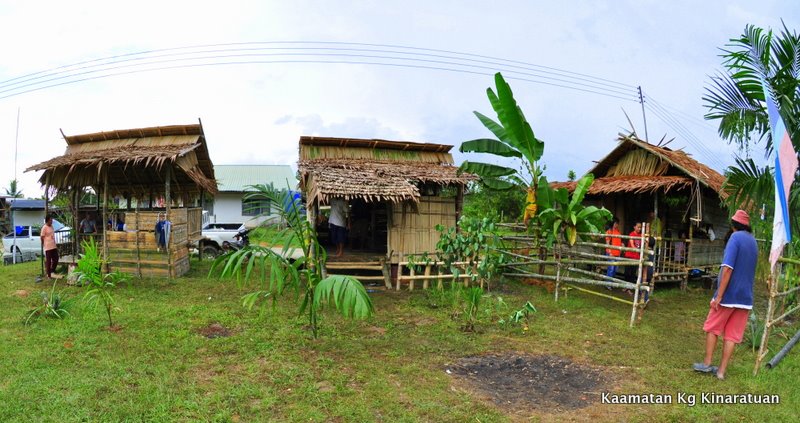
This is how they look like. Sinurambi, the dwelling place of the Dusun long ago. (Well, not quite- some Dusun in some villages still live in huts like these). I haven't seen these in my (father's) kampung for years, except in the tumoh (farms). Not in the actual housing areas, in which the houses you can see are the standard brick/wooden combination. This year, the Kaamatan organizers came up with this wonderful idea of having 'most impressive sinurambi' competition. I would say this is not one easy competition. A lot of efforts and time are involved, but the villagers delightedly participated. They were divided into groups, and it took them days to build their sinurambis. Not an easy task at all. Selecting the best bamboos, manata' (flattening the bamboo in order to make the floor and walls), putting the parts together. The architecture might not seem much, but I am proud to see these. To me, this is one of the most meaningful aspects of kaamatan. Popotungkus do koubasanan kumaa doid sukod wagu (passing down tradition to the young generation).
(The winner of the most impressive sinurambi competition) I regret not being able to go back to my kampung (duty call). Thankfully hubby shared these pics. Kotobian tadau kaamatan folks. May the year ahead is abound with blessings and fruits of your labour!